DUI arrests and convictions have collateral consequences on your job, your freedom , your driver’s license and several other areas of your life. The NFL has proposed some consequences of a DUI charge for its players. The NFL is pushing for a mandatory suspension of any NFL player convicted of a DUI . Some reports indicate that a one game suspension is being discussed between the NFL and the players union.

Is there a double standard in how the NFL treats its owners verses the players ? Colt’s owner Jim Irsay was arrested on drugged driving charges where he had prescription bottles in his car along with $29,000.00 in cash. The NFL has taken no action .NFLPA President DeMaurice Smith has criticized  the NFL’s handing of Irsay’s arrest . What is good for the goose is good for the gander . The NFL should adopt the same standards for the owners and team employees as the players. Suspend them one game of revenue just like the players. If you have $29,00.00 in your car you should be able to afford a cab or maybe he should have Uber on his phone.

Yesterday , I posted a link to a article on social media about boating under the influence cases. Here is a link to the article . I got a question that I thought was worth sharing . The question was does a boating under the influence charge effect your Tennessee driver’s license.

The short answer is no. A boating under the influence charge has zero impact on your Tennessee driver’s license . A conviction of a BUI does come with some consequences like loss of your boating privileges .

Have a safe summer. Also , you can follow me on Twitter  https://twitter.com/robmckinney or visit our facebook page .


This scene happens all too often . No court today because I was finishing up a brief that is due soon. I get a phone call from a family law attorney.

Attorney: Can a client avoid jail under Tennessee law ?

Me: No

Attorney: What about public service or the DUI Education Center ?

Me: No Public service. No DUI Education Center because the judge in your case will not allow it.

Attorney: How did you know who the judge was ?

Me: I looked it up and read the warrant of your client. Did you think about the traffic stop ? The community caretaker exception may not apply.

Attorney: What is the community care taking function ? I just wanted to plead them guilty .

Bottom line was that a family law attorney got a DUI case . The attorney wanted a quick fee. The family lawyer knows jack about a DUI case. No thought about the case. No knowledge of the law. No advice on how a DUI conviction impacts a person’s life.

The take away is to hire a experienced  DUI Defense Lawyer.

Do not hire a divorce lawyer, a civil lawyer , or any other type of lawyer. DUI law is specialized. Hire a professional


The erosion of the Fourth Amendment is continuing at a rapid pace. I don’t know which will happen first.The disappearance of the Fourth Amendment or the melting of the North Pole. The U.S. Supreme Court dealt another body blow to the Fourth Amendment in Navarette v California . In Navarette , The Supreme Court of the United States ruled that an anonymous tip can be the basis for a traffic stop.


Under the court’s ruling , a person sitting at Whiskey Dick’s in Murfreesboro can call into to the police and report someone was leaving drunk . Better yet , a off-duty police officer makes the call. The court has opened the floodgates for traffic stops. Here is what Justice Scalia said in his dissent;

"After today’s opinion," said Scalia, "all of us on the road, and not just drug dealers, are at risk … "

Justice Scalia was referring to the unfettered discretion of police officers to stop cars. Tennessee has already gone to this standard a few years ago when the Tennessee Supreme Court decided  Hanning .The bottom line is you will see more of these anonymous call traffic stops . Soon folks might be alerting the police on Twitter if they think there is a drunk driver on the road. I think the better rule is that police officers must see something to corroborate the callers information.

My takeaway is that the Fourth Amendment now has more exceptions to the search and seizure requirement than it has real teeth to prevent unlawful seizures. .On the other hand when courts review the Second Amendment there are no exceptions.


As I was driving to General Sessions Court in Springfield , Tennessee today , I was listening to a story on NPR . The storyline was about what happens when someone convicted of a crime can’t pay their fees. Often times , it  appears that someone who can’t pay the fines or fees are now sent to jail. The growing trend is to bill the defendant for everything from jail fees , probation fees and fines. Here is a link to a chart setting out all court fees state by state. As you can see , Tennessee charges all the fees it can by law. Here is a list of common court fees;


Pre-conviction

  • Application fee to obtain public defender
  • Jail fee for pretrial incarceration
  • Jury fees
  • Rental fee for electronic monitoring devices

Sentencing

  • Fines, with accompanying surcharges
  • Restitution
  • Fees for court administrative costs
  • Fees for designated funds (e.g. libraries, prison construction, etc.)
  • Public defender reimbursement fees
  • Prosecution reimbursement fees

Incarceration

  • Fees for room and board in jail and prison
  • Health care and medication fees

Probation, parole or other supervision

  • Probation and parole supervision fees
  • Drug testing fees
  • Vehicle interlock device fees (DUIs)
  • Rental fee for electronic monitoring devices
  • Mandatory treatment (includes drug and alcohol,) therapy and class fees

Poverty penalties

  • Interest
  • Late fees
  • Payment plan fees
  • Collection fees

What happens in Tennessee if you can’t pay your fines and court costs ?  First , file a motion to have yourself declared indigent in hopes the court waives your fines and costs. Secondly , the court could issue a probation violation based upon your failure to pay the court costs and fines. Under Tennessee law and case law from the U.S. Supreme Court , the state must show you had  an ability to pay the fine and costs. I was shocked to hear what goes on around the country . Tennessee judges for the most part will not throw someone in jail for not paying their fees. In Nashville , criminal court judges routinely waive the jail fees.  


The problem in Tennessee is your loss of your driver’s license. A couple of years ago , the state passed a law that if your fees and fines weren’t paid by the conclusion of your probation then your driver’s license would be revoked. This law has created a whole new problem in that once your license is revoked . You can’t get to work. You lose your job or commit a crime by driving on a revoked and the cycle just continues.


I understand the need for government to shift the costs to those commit the crime but at what costs that creates an endless circle of despair.

On this day in 1988 , The United States Supreme Court allowed a search of a person’s trash without  first obtaining a search warrant . Since that ruling a trash pull has become a standard police tactic in drug crime investigations. Once you put your trash can to the curb , the police can sift through your garbage looking for evidence of a drug crime. They will be looking for packaging material , seeds and stems , and paperwork.

The court ruled that the trash searches did not require a search warrant . The court found there was no expectation of privacy because it was common knowledge that people rummaged through trash cans. Justice Brennan wrote the dissent. and reasoned the following ;

[t]he mere possibility that unwelcome meddlers might open and rummage through the containers does not negate the expectation of privacy in their contents any more than the possibility of a burglary negates an expectation of privacy in the home.

Justice Brennan’s opinion is more true today than in 1988. Thanks to the NSA and identity theft going through other peoples trash is just a bad idea. For example , I sneak out at midnight on the day before the trash is picked. I sift through the garbage and take something. I just committed a theft. I exercised control over a item without the owner’s effect consent. How can we justify allowing the police search my garbage if I set it on my property for roadside pick-up. Maybe it is time to revisit the constitutionality of trash pulls ?

One of the blogs that I read is Seth Godin’s blog. It has a ton of information on business . One of his posts this week was on emotional hand-washing . Here is the post ;

Emotional handwashing

Emotions are far more contagious than any disease. A smile or a panic will spread through a group of people far faster than any virus ever could.

When you walk into the office or a negotiation, then, wash your bad mood away before you see us. Don’t cough on us, don’t sneeze on us, sure, but don’t bring your grouchiness, your skepticism or your fear in here either. It might spread.

.

The post made me think about how criminal defense lawyers carry themselves in the court room. If your loved one yelled at you before court or your kid didn’t do his homework or whatever upset you. You must wash those bad moods or feelings from your consciousness. Enter the courtroom with a smile on your face before you speak with the District Attorney . Be positive . Forget about what upset you this morning. It might make the difference in a favorable plea bargain. Save the bad mood for the police officer during a preliminary hearing .


I was reviewing my material for a CLE presentation  for the Tennessee Bar Association tomorrow. The topic I was assigned was the " Nuts and Bolts of DUI Defense ". One of the big mistakes that I witness among  Tennessee DUI  lawyers is identifying the issue. While I was at the Trial Lawyers College , one of the instructors asked me how I would hunt buffaloes. Would you use a rifle or a shotgun ? The takeaway point is if you are going to bring down a big animal . You want a laser guided scope on a rifle to bring it down. Much is the same in a DUI trial. Instead of fighting every issue , focus on the key issue that can bring home a not guilty verdict.

Here is a short list to help in identifying the issues in a DUI case ;

  • What was the driving ? was there probable cause to stop the accused ? Was there evidence of good driving ?  Physical control case ?
  • Did the accused make a admission of drinking ? How many ? Duration ? Time of last alcohol consumption ?
  • Was there physical evidence in the car ?
  • Field sobriety Tests ?
  • Was there a video ?
  • How was their interaction with the police ?
  • Witnesses ?

Once you identify the issue of the case , then you will be able to craft your theory of innocence. The key point is don’t shoot a buffalo with a shotgun . Find your one or two key issues and drive your point home.

One of my interests in the many components of the criminal justice is the area of forensic science . There has been a common occurrence of problems in  forensic crime labs across the country . One of the biggest cases was of Annie Dookhan who falsified thousands of drug reports . Ms. Dookhan was later indicted and plead guilty to her  crimes.

Alabama has found a way to avoid any problems in the forensic laboratory . They don’t need no stinking test. Robert Siercks was convicted of possession of cocaine. The evidence at trial was that the rock type substance recovered by the police was cocaine . How did they prove it was cocaine ?  The officer testified based on his experience and the field test that the substance was cocaine. The officer preserved a piece of the substance but no forensic testing was performed . A jury convicted Mr. Siercks and his appeal to the Alabama Court of appeals was denied. Mr. Siercks  was sentenced to 15 years .

The prosecutor had this to say ;

"There is no constitutional requirement that the prosecuting authority provide any particular ‘type’ of evidence in any case," Barnett said. "The only constitutional requirement is that the jury be convinced beyond a reasonable doubt as to the elements in a case."

Granted , there is no constitutional requirement of  forensic testing in drug cases , but do we want to guess it is drugs before we send Mr.Siercks off to prison for 15 years. Based on Alabama’s reasoning, a police officer could look or sniff someone and testify someones blood alcohol level is over .08 % alcohol. If you have a crime lab use it. The sad thing is that Tennessee has upheld a conviction based on a field test. I am glad to report that is a rarity and most drugs are eventually tested by a forensic crime lab.

I agree that there is no requirement to scientifically prove something is an illegal drug . Maybe it is about time.

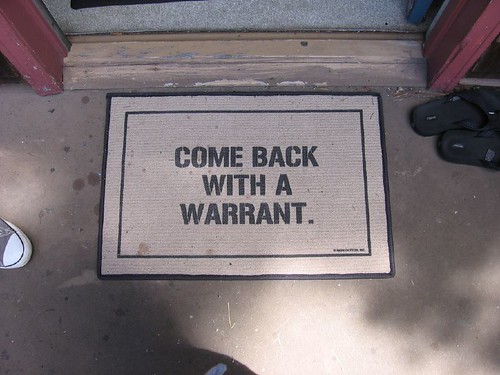
One police tactic is the ‘ knock and talk " . Basically , the police may not have enough information for a search warrant but they have a tip or suspect some type of criminal activity. It begins with a police officer knocking on the door then requesting to come in in to the house to talk. The police hope to see some evidence of a crime , drug activity , or the smell of marijuana . One thing to remember , you do not have to answer the door for the police or the Amway salesman.

The Indiana Court of Appeals recently suppressed the evidence from a knock and talk search. The homeowner refused to answer the door. The police waited forty-five minutes after the initial refusal . One officer looked into a window where he saw beer cans. a tow truck was called to tow a  parked truck. The officers threatened that the truck would be towed if no one came to the door. finally , the folks inside answered the door and you can guess what happened next. charges of underage alcohol consumption.

The Indiana Court ruled the search was illegal and the police overstayed their welcome . Relying on Florida v. Jardines 133 S. Ct. at 1414 , the court held ;

[W]hen it comes to the Fourth Amendment, the home is first among equals. At the Amendment’s very core stands the right of a man to retreat into his own home and there be free from unreasonable governmental intrusion. This right would be of little practical value if the State’s agents could stand in a home’s porch or side garden and trawl for evidence with impunity . …

The takeaway is don’t answer the door if police come knocking. Secondly , a man’s home is still his castle for the time being.

Thanks to the Fourth Amendment , you can read their analysis here .