Dominique Strauss-Kahn is back in the news. Strauss-Kahn gave a statement a recent statement about wanting to be "left in peace". Then , his lawyer declared his defense to the prostitution charges.

First , the defense to a prostitution charge via The Jury Room Blawg . It seems Strauss-Kahn’s lawyer is advancing the defense  that he did not know they were prostitutes . The  theory is the ladies were naked. How could one know they were prostitutes if they were in a state of undress ? Here is his lawyers comments;

However, Strauss-Kahn’s lawyer, Henri Leclerc, said his client was “totally unaware” the women were being paid. “At these parties, people were not necessarily dressed, and I defy you to tell the difference between a naked prostitute and any other naked woman,” said Mr Leclerc.” 

I get it . Beautiful young ladies want to have sex with an old , fat , white guy. Yeah right. I suspect that defense would work well here in Nashville’s bible belt.

The second reason DSK is back in the news is his request to be left in peace. Facing criminal charges is not the time to sound indignant. It is the time to fess up.Admit you’re human.  Most folks understand a person can make mistakes. DSK’s statement is the perfect example of how not to handle a public relations nightmare. Were are are forgiving group of people. Make a mistake. Own it. Unless the cops can’t prove it.
 

Montana has a Castle Doctrine as a defense to a murder charge.  However, it is currently being reexamined.  Heather Fredenberg had an affair with Brice Harper. Her husband, Dan Fredenberg, found out about the affair and went to Mr. Harper’s house to confront him.  Mr. Fredenburg walked though a open garage door where he was shot and killed.

Prosecutors declined to press charges stating Harper was protected by Montana’s Castle Doctrine law.  Harper believed he was about to be assaulted; therefore, his use of force was justified under the law even though Fredenberg was unarmed.

County Attorney Ed Corrigan, in a letter (PDF) to members of the Kalispell Police Department, outlined his reasoning for not pressing charges against Brice Harper.  Mr. Corrigan relied on Montana’s version of the Castle Doctrine, a prior altercation between the parties and Mr. Harper’s statements at the time of the killing.  The biggest issue was that that Mr. Fredenberg, who again was unarmed, was shot three times.

Here is Tennessee’s version of the Castle Doctrine:

 Notwithstanding § 39-17-1322, a person who is not engaged in unlawful activity and is in a place where the person has a right to be, has no duty to retreat before threatening or using force intended or likely to cause death or serious bodily injury, if:

    (A) The person has a reasonable belief that there is an imminent danger of death or serious bodily injury;

   (B) The danger creating the belief of imminent death or serious bodily injury is real, or honestly believed to be real at the time; and

    (C) The belief of danger is founded upon reasonable grounds.

(c) Any person using force intended or likely to cause death or serious bodily injury within a residence, business, dwelling or vehicle is presumed to have held a reasonable belief of imminent death or serious bodily injury to self, family, a member of the household or a person visiting as an invited guest, when that force is used against another person, who unlawfully and forcibly enters or has unlawfully and forcibly entered the residence, business, dwelling or vehicle, and the person using defensive force knew or had reason to believe that an unlawful and forcible entry occurred.

;

The basic principle is that a man’s home is his castle. He can protect his family or himself while at home. The defense is very similar to the defense being used in Florida in the Zimmerman case.
 
The question posed is should it be a defense to kill someone at your home under certain circumstances ?


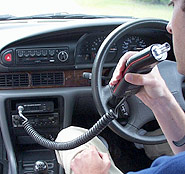
Should everyone in America blow in a breath test machine before they start their car ?  That is exactly what Newsday is proposing in an editorial in reaction to a police officer’s tragic death. Officer Joseph Oliveri was responding to a car accident in which James Ryan hit some cars. It is alleged that Mr. Ryan was driving while under the influence. Officer Oliveri was working the accident when another car hit and killed him. . NewsDay now wants all cars to have a breath alcohol machine installed.

The first question is should  lawmakers requires ignition interlock devices in all cars in America to combat drunk driving ?  Everyone agrees that driving under the influence is a serious problem . Drunk driving causes accidents , serious injuries , and death every single day. No one is in favor of getting behind the wheel drunk. However , should the threat of drunk drivers imprison everyone who owns a car by having a device on the car. Consider if the law takes effect requiring everybody to blow. There will be no more dinners with a glass of wine.  Having a beer at a football game done.

My father had a saying that you can’t legislate morals. Does society create a new prohibition ? Our country must find the root of the problem . A solution is needed and it is not to require every car in America to a alcohol testing machine on board. In my career , I have seen the blood alcohol levels go from .15 % BAC to .08% BAC. Punishment increases with each legislative year.Here is a great comment on the problem via Scott Greenfield;

  More importantly, the solution to individual impropriety isn’t to hold those who have done no wrong, and wouldn’t do wrong, captive.

I agree with Mr. Greenfield. The solution to the problem of drunk driving should be measured to only punish the guilty. I fear that the government’s way is to arrest everyone no matter how slight the evidence. Newsday’s solution is just make everyone blow. Different folks have different ideas. Newsday’s option just does not follow common sense.


Federal Judge Richard Posner has recently spoken in favor of legalizing marijuana and abolishing many of the country’s drug laws. What gives more weight to his position is his status. Judge Posner is a widely respected federal judge and is considered a conservative .Here is some of his comments;

"Personally, I don’t think we should have a fraction of the drug laws that we have. I think it’s really absurd to be criminalizing possession or use or distribution of marijuana," Posner said, prompting applause from the audience at Elmhurst College in Illinois. "I can’t see any difference between that and cigarettes."

I’m skeptical about the other drug laws. I don’t know how much we know, for example, about whether cocaine is really a disabling drug or whether it’s something people can take and lead more or less normal lives. Clearly there are, you know like LSD, obviously very dangerous drug, although I don’t think we have a good idea how many people really jump out of windows because they’re taking LSD. … There are problems, but I think the notion of using the criminal law as the primary means of dealing with a problem of addiction, of misuse, of ingesting dangerous drugs, I don’t think that’s sensible at all. And that is responsible for a high percentage of our prisoners, and these punishments are often very, very severe.


Is it time America rethinks the legality of its marijuana laws ? What do you think ?


Mt. Pleasant High School quarterback Princeton Harlan has been charged with the rape of a child in Maury County. Also, two of his teammates were charged with raping the same victim. The big difference is how they will be treated by the criminal justice system. Harlan is over 18 and will be tried as an adult . Harlan’s teammates are juveniles; their fates have not been decided. The two minors might be tried as juveniles or the State of Tennessee could move the Maury County Juvenile Judge to transfer their cases to adult court.

The big difference is punishment. Harlan faces 25 to 40 years in prison with no possibility of probation or parole. His teammates, if tried as juveniles, will face prison.

Maury County Sheriff’s Detective Tony Bailey reported that Harlan and his two teammates had sexual contact with the girl in two separate incidents.

First , rape of a child is one of the worst crimes that are committed. The punishment is severe. It is just wrong both legally and morally. The difference in this case is the age of the defendants and the victim. The key wording in the rape of a child statute is "the unlawful sexual penetration." It appears these acts were not forcible.

On a side note , will this case be used for means other than to protect a young girl and punish those who deserve it ? Let’s look at how Mr. Harlan was arrested . The case has been investigated since August. Mr.Harlan was not a flight risk. Yet the Maury County Sheriff’s Office chose to arrest him at school. Mr. Harlan had to do the perp walk in front of his classmates. Harlan’s arrest was a staged public event in stark contrast to the direct presentment of the charges to the Grand Jury (which avoided a preliminary hearing).

Mr. Harlan was wrong and the girl was victimized. The Tennessean’s headline in an article by Brian Hass stated " Child Rape Case A Challenge." It certainly will be.


Jerry Sandusky is going to prison to serve between 30 to 60 years for being convicted of over 40 counts of abusing children. I am not sure of his convictions. The news reports just refer to molesting children or sex abuse. Under Tennessee law, it could be rape of a child or aggravated child abuse. Those crimes carry tough sentences. Rape of a child carries 25 to 40 years to serve at 100%. Aggravated sexual battery carries 8 to 12 years as a Range I offender at 100%.

If Sandusky was sentenced in Nashville, my prediction is that he would have gotten a sentence into the triple digits due to consecutive sentencing. Why? Tennessee allows consecutive sentencing if a defendant has been convicted of two or more statutory offenses involving sexual abuse. Tennessee Code Annotated 40-35-115 sets out when consecutive sentencing applies.

40-35-115. Multiple convictions

(a) If a defendant is convicted of more than one (1) criminal offense, the court shall order sentences to run consecutively or concurrently as provided by the criteria in this section.

(b) The court may order sentences to run consecutively if the court finds by a preponderance of the evidence that:

(1) The defendant is a professional criminal who has knowingly devoted the defendant’s life to criminal acts as a major source of livelihood;

(2) The defendant is an offender whose record of criminal activity is extensive;

(3) The defendant is a dangerous mentally abnormal person so declared by a competent psychiatrist who concludes as a result of an investigation prior to sentencing that the defendant’s criminal conduct has been characterized by a pattern of repetitive or compulsive behavior with heedless indifference to consequences;

(4) The defendant is a dangerous offender whose behavior indicates little or no regard for human life and no hesitation about committing a crime in which the risk to human life is high;

(5) The defendant is convicted of two (2) or more statutory offenses involving sexual abuse of a minor with consideration of the aggravating circumstances arising from the relationship between the defendant and victim or victims, the time span of defendant’s undetected sexual activity, the nature and scope of the sexual acts and the extent of the residual, physical and mental damage to the victim or victims;

(6) The defendant is sentenced for an offense committed while on probation; or

(7) The defendant is sentenced for criminal contempt.

(c) The finding concerning the imposition of consecutive or concurrent sentences is appealable by either party.

(d) Sentences shall be ordered to run concurrently if the criteria noted in subsection (b) are not met, unless consecutive sentences are specifically required by statute or the Tennessee Rules of Criminal Procedure.

A Tennessee judge imposing a sentence could have given Sandusky time in the triple digits at 100%.

That is why it is important to file a motion for a severance of counts in a Tennessee sex crimes case. More on a motion to sever later…

Jerry Sandusky appeared in court today for his sentencing hearing. Pennsylvania is like Tennessee in where the judge sentences a person after the jury determines guilt or innocence. A sentencing hearing is a very important stage of the case.It went poorly for Sandusky and it is likely he will die in prison. Sandusky did two things wrong at his sentencing hearing.

First , a tape was leaked where it is alleged that he made a statement about the case. The Patriot News published the full statement. Here is just a portion ;

“I’m responding to the worst loss of my life. First, I looked at myself. Over and over, I asked why? Why didn’t we have a fair opportunity to prepare for trial? Why have so many people suffered as a result of false allegations? What’s the purpose? Maybe it will help others; some vulnerable children who could be abused, might not be because of all the publicity. That would be nice, but I’m not sure about it.

“I would cherish the opportunity to become a candle for others, as they have been a light for me. They could take away my life, they could make me out as a monster, they could treat me as a monster, but they can’t take away my heart. In my heart, I know I did not do these alleged disgusting acts.

“My wife has been my only sex partner that was after marriage. Our love continues.

“A young man who was dramatic, a veteran accuser, and always sought attention, started everything. He was joined by a well-orchestrated effort of the media, investigators, the system, Penn State, psychologists, civil attorneys and other accusers. They won. I’ve wondered what they really won: Attention, financial gain, prestige will all be temporary.”

It is not a good idea to give a taped statement on the eve of a sentencing hearing when you are asking the court to impose a light sentence.

Secondly , it appears his statement in court again claimed his evidence against enormous evidence of his guilt. Testimony before a judge must include remorse and feelings for the victims rather than they made it all up. Judges expect you to fight the case , but once you are convicted all judges want to hear that you are truly sorry for the conduct that lead to the criminal behavior.


A 18 year old Massachusetts teen was sentenced to one year in prison after being convicted of vehicular homicide in a texting while driving case. Aaron Deveau crossed over the center line and hit a car killing the driver . Deveau initially stated he was thinking about his homework when he veered suddenly to avoid rear ending a car . As he tried to avoid a crash , he ran into another driver. Prosecutors argued that Deveau was texting and driving. There was evidence of 193 texts that day including one minutes before the deadly crash.

In Tennessee , it is illegal to text and drive . It carries a $50.00 fine. However , law enforcement officials state it is hard to enforce since cell phone use is not banned. Yet the question remains , could someone be charged with vehicular homicide in Tennessee if they we texting and driving. The answer is they could. One could be found guilty if the reckless killing was the proximate result of conduct creating a substantial risk of death or serious bodily injury to a person. From all the data and reports , everyone knows it is dangerous to text and drive. If the state can prove you were texting and driving , it appears they can make their case. However , other factors could be present to avoid a conviction. Remember , the conduct of texting and driving has to be the proximate result of the accident

Continue Reading Teen Convicted of Vehicular Homicide While Texting

I read a blog post today at  Simple Justice. Scott Greenfield wrote about whether we put too much into what the Supreme Court rules. Does their rulings affect the criminal defense lawyers in the trenches ? I do agree with his arguments that some in the legal world will analyze a ruling to the last period. An example of this the the famous footnote 9 in the  Schmerber case.

Yes, the court’s rulings in the area of  criminal defense do matter. A lawyer that keeps up to date can set aside a plea bargain deal when a prior lawyer does not advise a client of immigration consequences. I love the Padilla case . I was able to use that case on a conditional plea bargain in Tennessee. I was able to free a young lady from a detention facility in Louisiana and have her case dismissed . I am hopeful that the court will affirm the McNeeley case on the blood alcohol draws. I have several clients whose blood was taken against their will and will now be used against them to prove their guilt . Maybe the U.S.Supreme Court will hold that the police cannot just take a blood sample without a valid search warrant. I may now be able to attack criminal convictions before the Padilla opinion was issued to young a young man from being deported. Some of these issues are on the court’s docket this fall.

The answer for me is that the Supreme Court is important in my practice. Do  I care about all their cases ? No. I could care less on whether someone can sue in the United States  on a human rights case that occurred elsewhere. I don’t always agree with the court’s rulings  but when they rule on a Fourth Amendment case or significant criminal issue . It does impact a lawyer in the trenches or their client facing a jail cell.


It is October 1, and the U.S.Supreme Court is back in session after the summer break. Now if only Justice Thomas will ask a question during arguments. It is a full docket for the court on issues that effect criminal defense lawyers. Here is a brief list of the cases that might impact you in the future ;

  • Florida v. Jardines   In Jardines , the issue is whether the police violated the Constitution by using a trained drug dog to sniff at the threshold of a house where they suspected marijuana was being grown. Apparently, there was no hard evidence of marijuana being grown so they ran a drug dog around the outside of the house. So , is it a search if the drug dog was just around the house. The Florida Supreme Court ruled is was a constitutional violation.
  • Missouri v. McNeeley    In McNeeley , The issue is whether the police can take a blood sample of an accused DUI driver without a search warrant based upon exigent circumstances. Tennessee has a law on the books that allows a forced blood draw of those that have had a prior DUI conviction. The Missouri Supreme Court ruled that since there was no accident to investigate and because there was plenty of time to get a warrant that the police needed to obtain a warrant.
  • Chaidez  v. United States , In Chaidez , the issue whether the ruling in Padilla applies to someone whose conviction became final before that ruling was announced. Padilla requires a criminal defense attorney to advise non-citizens that a guilty plea may carry the risk of deportation.
  • Ryan v. Gonzales  In Ryan , the issue is whether a defendant needs to be mentally capable in assisting his own attorney in challenging a death penalty conviction.

The Court has a full slate. The first two cases are important in the application of the Fourth Amendment. The power of the protection of the Fourth Amendment has waned over the last couple of terms of court. Are we going to allow the police to take bodily fluids without a search warrant then run drug dogs around our house.