The Tennessean’s, Frank Daniels, III, wrote a recent opinion piece on The Tennessee Plan for judicial selection. Mr. Daniels urges Tennesseans to push for the right to popularly elect judges. Currently, the Supreme Court, the Court of Appeals, and the Court of Criminal Appeals are not elected by popular vote. I do not know if Mr. Daniels has ever stepped foot in a courtroom or his experience  in the field. However, take it from someone that spends the majority of his days in our Tennessee courtrooms, Mr. Daniels’ call for a partisan election is foolish.

First, a little history is in order. In 1971, Tennessee enacted a plan for merit selection for all judges on the Tennessee Supreme Court, Court of Appeals, Court of Criminal Appeals and vacancies at the trial court level. The goal was to remove political influence, money pressure from special interest groups in hopes of  providing better administration of justice. Also, the judges were vetted by a selection committee. For more than forty years, the Tennessee Plan minimized partisan politics and focused on selecting the best judge possible. More than thirty-four states have this plan.

Mr. Daniels’ call is based on Article VI, Section 3 of Tennessee’s Constitution, which provides that the judges be elected by qualified voters of the state. The spirit of the Constitution is being followed by the retention election. Once a judge is appointed, the judge must be retained for future service. In fact, the voters have voted out a supreme court judge in the past. Here is an excerpt from Mr. Daniels’ column:

"We will hear a lot about how bad it will be for our judges to be part of a political process; how corrupting money in campaigns can be; how voters don’t take the time to know much about the candidates for judge; and how a merit selection process ensures that our judges will be impartial.

To me, that all sounds like manure."

That is exactly why the current system should remain in place. If we do away with the current plan, it opens up the door for abuse by people like billionaire brothers dumping cash into elections and even some special interest groups buying justice. John Grisham wrote about the possibility of this very issue. Further, there is one election in West Virginia that was bought and paid for by a coal mine operator.

The Tennessee Bar Association has created some information on the subject. You can read the pdf here.

Let’s keep money, politics, and special interest groups out of the courtroom and the appellate courts. Let’s keep the Tennessee Plan.

Here is a follow up to yesterday’s post on the proposed law to allow open carry of firearms in Tennessee. Currently, T.C.A 39-17-1307 makes it illegal to carry a handgun at a place open to the public where one or more persons are present. It is currently a Class A  misdemeanor and a punishment of up to 11 months and 29 days in jail. The new law will repeal this law.

Why is this law a terrible idea? Can you imagine the chilling effect to Nashville tourism. People walking the streets of lower Broadway "packing heat." It is not a sight that makes people come to Nashville. How about Memphis in May? Imagine Beale Street  with "a few guns" around?

Gun rights must be balanced with common sense about public safety. All bills must have a fiscal note or how much a bill will cost the State to enact the law. Has the Tennessee Senate thought about lost sales tax revenue from people not visiting Nashville?

I just do not see a problem with the current handgun carry permit law that is now in effect. If it ain’t broke, don’t fix it. Unless your trying to get campaign donations from the gun lobbyists.


Senator Mae Beavers led the passage for one of the dumbest laws ever passed by the Tennessee Senate. The Open Carry Firearms Freedom Act  would allow a person to openly carry a firearm around the streets of Tennessee . No more of those pesky handgun permits where your criminal record is checked . No more of those firearm safety classes. Just strap your Glock on your side and walk around. Beavers stressed the true point was removing the $ 115.00 fee for the carry permit.

The number one goal of government is to ensure the safety of the public. I for one will not be safe knowing that most people will now have a gun in their car , purse or strapped on their side. I am sure the police and law enforcement want everybody to be armed when they stop someone for a speeding ticket.

The days of the wild west is over . Gunfights in the streets belong in a different era. I have not heard one complaint about the handgun carry permit process .The cost is small for some basic checks for the safety of the public. I own firearms , but this bill is insane . Our Legislature is out of control or better yet is controlled by special interest groups like the gun lobby. My only hope is that the House will stop this bill. I have seen what a handgun does. It kills people , lives destroyed ,heartbreak. This bill will create more shootings . The violence must stop.

In Davidson County and Rutherford County , there are contested elections for the office of District Attorney. Some voters just have a vague notion of what the duties are of the District Attorney. I have a confession to make, even though I have been practicing criminal defense law since 1994, I never read what the statutory duties are of the District Attorney are until this year.  I was researching what duties are not delegable. In thinking about the election, I thought I would share what are the duties of the District Attorney General.

The office of District Attorney General was created under Article VI Section 5 of the Tennessee Constitution. The Tennessee Legislature spelled out the duties of the District Attorney General in T.C.A. 8-7-103.

Each district attorney general has the following duties:

(1) Shall prosecute in the courts of the district all violations of the state criminal statutes and perform all prosecutorial functions attendant thereto, including prosecuting cases in a municipal court where the municipality provides sufficient personnel to the district attorney general for that purpose;

(2) Shall prosecute in the federal court all criminal cases removed from a state court in the district to any inferior court;

(3) May cooperate and assist, upon the request or direction of the attorney general and reporter, in the bringing, prosecution, defense, preparation, and trial of all cases in the circuit and chancery courts in which the attorney general and reporter is required to appear for the protection of the state or the public interest;


(4) Shall give an opinion, without charge, whenever called upon by any county officer in the district, upon a question of criminal law relating to the duties of the county officer’s office;

(5) Shall submit to the office of executive director for the district attorneys general conference within ninety (90) days after the end of each fiscal year, a written report specifying: 
 
(A) Each source from which funds were received by the office of the district attorney general during the fiscal year;
 
(B) The amount of funds received from each source; and
 
(C) The disposition of such funds;
 
(6) Shall have discretion in the performance of duties and responsibilities in the allocation of resources available to such district attorney general, any other provision of law notwithstanding; and
 
(7) Shall have authority to delegate the foregoing duties and responsibilities to an assistant district attorney general.
 

The power to prosecute criminal cases is a great power . I remember the line in Spiderman , "with great powers comes great responsibilities".

I was born and raised in Nashville, with my sisters Janice Podis Hertz and Vicky Podis Jacobs. My parents, Micky and Sylvia Podis, always instilled in us a sense of community service. I graduated from Bellevue High School. I earned my Associates in Social Work from Aquinas Junior College and my BS in Sociology from Tennessee Tech. I attended Cumberland School of Law of Samford University in Birmingham, Alabama, an American Bar Association accredited school, from 1983 to 1986. I was a member and contributing writer to the Cumberland School of Law Trial Journal from 1984 to 1986, and participant in the mock trial program. I was honored to receive the Proctor in Admiralty.
From June 1985 to August 1985, I participated in a student swap program coordinated between the Cumberland School of Law and Stetson Law School, in Pinellas County, St. Petersburg, Florida, under the guidance of the Office of the Public Defender, 20th Judicial Circuit, St. Petersburg, Florida. As a third year law school student, I personally tried many misdemeanor bench trials for indigent defendants, appointed to be represented by the Office of the Public Defender.
After taking and passing the bar exam in the summer of 1986, I was admitted to the Tennessee Bar October 11, 1986, and became a member of the Nashville and the Tennessee Bar Associations.
I have been actively practicing law for over 26 years. I began my practice in the office of Jack Green on Nolensville Road in Nashville. I learned so much from Mr. Green and began handling a variety of cases from personal injury, divorce, Social Security Disability and working on the Mental Health Docket at General Sessions. I have handled over 35,000 files, including consumer bankruptcy. My office has been in the same location on Murfreesboro Pike for over 24 years.
I have raised my son Jeff Podis in Nashville and am proud to say he is thriving as a Sophmore at Centre College of Kentucky. I have been married to Cindy Podis for ten years in January.
I am running for General Sessions Court Division II because I have a strong belief the judicial system should be fair and just to everyone, no matter the socio-economic background. Everyone should be treated equally. My platform of equal justice for all, rich or poor, encompasses the motto I have lived by my entire life. I do quite a bit of pro bono work each year to ensure everyone has access to the courts. It is an important part of my legal practice.
I believe General Sessions Court is the Court in which most citizens come into contact, from either traffic tickets or small claims actions. It is important for everyone to see the system is fair to all.

In more than three dozen cases across the country,  rap lyrics are  playing a major role in criminal trials. Gangsta rap is a genre of rap music that embraces a violence, drug deals, and shootings. The explosion in the use of rap lyrics at trial are causing some criminal defense lawyers concern. The lyrics are being used to inflame jurors and prejudice the accused.  In most cases, the lyrics represent a confession to the crime.

Here are some of the theories for the introduction of rap lyrics:

  • As a criminal act in themselves.

In Illinois v. Oduwole, the government used the lyrics themselves as a threat against campus police.

  • As evidence of motive and intent.

Rule 404 (B) of the Tennessee Rules of Evidence allows use of this type of evidence to prove intent.

  • As a confession.

In most cases, the lyrics are a confession of the crime. In the case of  Antwain Steward, the main piece of evidence is the rap lyrics, which give a detailed confession of the murder.

There are rules of evidence that support the government’s use of rap lyrics.

1. The confession in a rap lyric may be considered a admission by a party-opponent. A statement by a party that has manifested an adoption or belief in its truth. In the Steward case, the rap song gives a general account of the murder though not identical.

2. The statement in a rap lyric may be introduced to establish intent, identity, a common scheme or plan. Tennessee Rule of Evidence 404 (B) allows the introduction of other crimes, wrongs, or acts. One of the purposes of the rule is to use that evidence to identify the perpetrator. How damning can a rap lyric be if the rapper details the murder in the lyrics.

The critical question is how does a court balance the use of rap lyrics verses the defendant ‘s right to a fair trial. It is a question that becomes more difficult with the increased amount of publicity regarding rap and some of the negative connotations that gangsta rap portrays.

Bottom line is that if you commit a murder, don’t write songs and sing about it. 


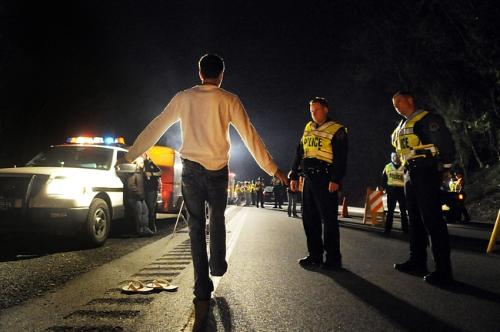
One of the major DUI investigation tools that police use are the standardized field sobriety tests. Most citizens accused of driving while intoxicated think that if they pass these tests they will not be arrested for DUI. Little do they know they can still be arrested, prosecuted, and face trial even if they pass the field sobriety tests. Who made that silly rule? Why the Tennessee Supreme Court, of course.

The question was recently asked of the Tennessee Supreme Court whether there was sufficient probable cause to arrest a citizen of DUI if they passed the field sobriety tests. In State of Tennessee v. Bell , the Court held other factors such as driving, smell of alcohol, and admissions of drinking are sufficient to create probable cause to arrest a citizen for DUI. The Court further opined that "even if Mr. Bell correctly performed the field sobriety tests, we decline to conclude that his performance sufficiently undermines the aforementioned circumstances so as to defeat a finding of probable cause for DUI."

What does this ruling mean to a citizen accused of drunk driving?

  • Never under any circumstances perform the field sobriety tests.
  • Refusal to perform the tests cannot be held against you.
  • Passing the field sobriety tests mean nothing. You will, more times than not, still be charged with a DUI.

Los Angeles DUI attorney, Lawrence Taylor, has often spoke on the DUI exception to the Constitution. The Bell case is just another example.


Citizens suspected of driving under the influence in Tennessee do have some rights during the arrest process. One of those rights is the ability to request an independent sample of your blood. The  purpose of this law is to give the accused the right to test his or her blood to determine if test is accurate. Typically, two blood samples are taken during the procedure. One is kept by law enforcement and tested, and the second sample is saved if the person who was arrested wanted to have it tested.

The question is how do you obtain a independent blood sample after having given a breath test sample? First, breath alcohol testing is routinely performed in Nashville, Davidson County, Tennessee DUI cases.  In the surrounding counties outside of Nashville, like Williamson County, breath tests are not used. I guess they do not trust the results. If you submit to a breath test you have the right to request that an independent sample of your blood be taken and also tested. Here is the procedure:  1)  Make the request. 2) Law enforcement must then take you to have the blood drawn.  Note, that you must be able to pay for the sample yourself. Law enforcement is not required to pay for your independent sample. 3)  Medical personnel, usually at a hospital, draws your blood. 4) You must arrange to have the sample tested, also at your own expense.

What happens if the sample you have asked for is taken? The appellate courts have ruled in two cases that failure to provide a defendant a independent sample is a due process violation. The remedy in these cases for a due process violation is a dismissal.

In State v Livesay, the Court dismissed a DUI charge because law enforcement did not allow the Defendant’s doctor to draw his blood while he was in jail. The Court held this was a due process violation. In State v Geselbracht, the Court of Criminal Appeals again held that it was a due process violation when the police denied Mr.Geselbracht a independent blood test.

The principle is that you have a right to request a independent blood test after you submit to a breath test. One interesting issue in all of these cases is the requirement that the defendant be able to pay for the sample himself. Who pays for the blood sample? What about people that may not have the money to pay for an independent blood sample? Is this also a due process violation?

Kerry Kennedy is on trial in a New York courtroom . The charge is driving under the influence of a generic form of Ambien . Most folks don’t realize they can be charged with driving under the influence of a prescribed  medication. Ms. Kennedy’s defense is that   she was rushing off to the gym and took a sleeping pill by mistake . After she failed the field sobriety tests , she agreed to a blood test where Zolpidem was found . Zolpidem is a generic form of the sedative Ambien . According to her lawyer’s opening statement , it was a simple mistake.

In Tennessee , mistake of fact is a defense . However , I don’t think it would apply in Ms. Kennedy’s case .Mistake of fact is a defense if it negates a mental element. Under Tennessee DUI law, there is no required mental element . Ms. Kennedy may have a  better defense under Tennessee law as to involuntary intoxication . By this I mean , she did not realize the effects of the medication when she took the pill.

There would be one roadblock in her DUI defense in Tennessee. A judge reads the jury the laws they must use in deciding the case commonly referred as a jury charge . In Tennessee , the judge would instruct the jury it  is not a defense to being driving a car under the influence of a prescription drug.

Reading her lawyer’s comments in a article on the trial , it looks like his real defense is she is such a good person that she would never do this type of thing. It might work if your name is Kennedy .


The U.S. Justice Department is taking a new approach on drug crimes. The department is encouraging low level convicted drug dealers to request clemency . Clemency would allow up to 12,000 inmates to be released early . The federal system is making the move to save money on the costs it takes to house a prisoner. They also realize of the inequities of the harsh drug sentences based upon mandatory minimum sentences.

Contrast the Federal approach verses the approach in Tennessee . Tennessee is going in the opposite direction. Several years ago the Tennessee Legislature passed the Drug Free School Zone Act which increased the punishment of drug offenses within 1000 feet of a schools zone as well as other types of locations like daycare centers. So if ones possess .5 gram of cocaine with the intent to sell or deliver within a 1000 feet of a school zone a defendant is looking at 15-25 years in prison at 100 %. . You drive by a school on the interstate with some drugs and you are in the cross hairs. The practical effect is the drug free school zone is used as a hammer to force plea bargain agreements where a prison cell is the next stop.

Now don’t get me wrong. Drugs in schools are a bad thing and should not be tolerated. However , the law does not require a nexus between the school or any activity and the criminal conduct . You just drive by the school and your guilty of a drug free school zone charge. Every bill in Tennessee must have a fiscal note attached as to let everyone know how much this is going to cost.

The question is whether we should put low level drug dealers in prison or try some measure to rehabilitate them. Common sense tells me that the drug free school zone laws are not being used for what they were designed . The decision to prosecute these cases have given too much power to the District  Attorneys . Fill up the prisons or solve the problem. The federal system seems to be moving towards fixing the problem . Which way will Tennessee move ?


Closing note. I put today’s blog post up for a vote on Twitter. Please comment on the blog or follow me on Twitter here https://twitter.com/robmckinney . Let me know what interests you.